
“Biodegradable” Is Becoming a Starting Point
For years, buyers comparing disposable food packaging could narrow a supplier shortlist by asking a simple question: is the product biodegradable? In 2026, that question no longer goes far enough. European packaging rules, PFAS restrictions and increasingly specific compostability programs are pushing purchasing teams to ask what a product is made from, how its claims were tested and which documents apply to the exact item being ordered.
That matters particularly when sourcing from a Biodegradable Disposable Tableware Manufacturer. Sugarcane bagasse and bamboo fiber may offer a practical alternative to conventional foam or plastic products, but renewable feedstock is only one part of the specification. Food-contact suitability, chemical composition, grease resistance and end-of-life claims have to be considered separately.
The regulatory direction is already visible. The EU Packaging and Packaging Waste Regulation began applying on August 12, 2026 and includes requirements affecting packaging composition, recyclability, labeling and PFAS in food-contact packaging. Maine’s restrictions on intentionally added PFAS in specified plant-fiber food packaging also took effect in May 2026.
That Makes Documentation Part of the Product
Because “biodegradable” alone does not answer those regulatory questions, the next step is to examine what evidence sits behind the product. A serious Compostable Tableware Manufacturer should be able to connect its commercial claims to testing or certification relevant to the target market instead of presenting sustainability terminology as interchangeable.
Food-contact documentation is one example. Products destined for the European market must satisfy the applicable food-contact framework, while compostability claims may involve separate standards and certification schemes. BPI, for instance, bases commercial compostability assessment on ASTM D6400, with additional standards available for eligible products. Its certification framework also includes criteria relating to fluorine and PFAS.
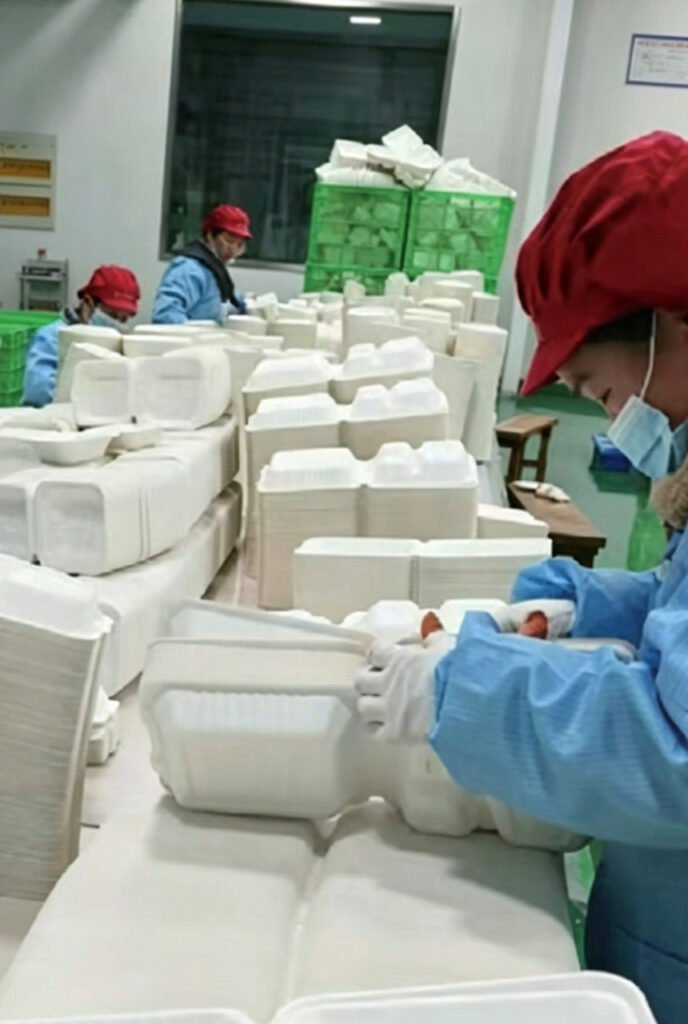
Regreen Global illustrates the type of documentation buyers can examine during supplier qualification. The company lists FDA, OK COMPOST, ISO 9001 and BRC credentials and publishes additional LFGB and EU food-contact testing files through its certificate section. Its Jiangsu plant is stated to cover 32,000 square metres with annual pulp-board processing capacity of 10,000 tons.
PFAS Has Changed the Bagasse Conversation
Once documentation becomes part of supplier evaluation, chemical barriers deserve particular attention. Molded-fiber packaging still has to resist oil, moisture and hot foods, which means buyers cannot assume that choosing plant fiber automatically answers every chemical-compliance question.
This is why recent product development is so revealing. Sabert’s PULPUltra range, launched across Europe, the UK and Ireland in 2026, uses approximately 95% bagasse fiber and specifically emphasizes no intentionally added PFAS alongside oil and grease resistance. The launch shows how performance and chemical specifications are increasingly being discussed together.
For a Bagasse Tableware Manufacturer, this changes the sales conversation. Saying that a plate or clamshell comes from sugarcane waste explains the feedstock, but buyers may still need SKU-level evidence concerning food contact, fluorine or PFAS testing, compostability and the coating or barrier system used to achieve functional performance.
Compostability Also Needs a Destination
The same evidence-based approach applies after the package is discarded. A product described as compostable does not necessarily behave identically in home composting and industrial composting, and those disposal routes should not be treated as synonyms.
EU guidance issued in 2026 specifically discusses industrial compostability when Member States impose additional compostable-packaging requirements. BPI likewise separates commercial compostability from its newer home-compostability program. Those distinctions mean an importer should establish where the product will actually be sold and how customers are expected to dispose of it before selecting the appropriate certification evidence.
A useful sourcing file therefore connects several questions rather than relying on one environmental statement:
- What plant fiber and barrier materials are used, which food-contact documents apply to the SKU, what compostability standard supports the claim, whether PFAS or total-fluorine information is available, and whether the container has been tested for the temperatures, oils and holding times expected in its real foodservice application.
The Better Supplier Is the One That Can Prove More
Once material, chemical and end-of-life requirements are viewed together, supplier comparison becomes much more practical. The strongest Eco Friendly Disposable Tableware Manufacturer is not necessarily the company making the broadest environmental promise; it is the one that can show which evidence belongs to which product and market.
For buyers considering a manufacturer producing biodegradable disposable tableware in China, that means requesting documentation before the final quotation is treated as complete. Certificates should be checked for scope, product identity and target-market relevance, while performance samples should be evaluated using the foods and service conditions the packaging will actually face.
The same standard applies when evaluating a compostable tableware supplier or a manufacturer specializing in bagasse tableware. Renewable fiber remains an important advantage, but 2026 procurement is increasingly about proof: proof that the material is suitable for contact with food, proof that restricted chemistry is controlled, proof that a compostability claim has a defined meaning, and proof that environmental performance does not come at the expense of practical foodservice performance.
That is a more demanding way to buy disposable tableware, but it is also a safer one. As packaging regulation becomes more specific, the manufacturers best positioned for international business will be those capable of turning sustainability claims into traceable specifications.